The Environmental Impact of AI: A Look at the Data
For nonprofit professionals, the "double bottom line" is always top of mind. We care about our mission, but we also care about how we achieve it. As AI becomes a standard part of the fundraising toolkit, a valid question has emerged: Does using AI conflict with our commitment to environmental sustainability?
The headlines regarding AI’s energy consumption, citing massive data centers and water usage, are real and concerning. However, when we drill down into the specific data regarding text-based generative AI (the kind used for grant writing and donor communications), the picture becomes more nuanced.
For organizations evaluating the environmental ethics of these tools, here is a summary of the current research.
1. The Carbon Cost of Task Completion (AI vs. Human)
When assessing environmental impact, researchers look at the total energy required to complete a specific task.
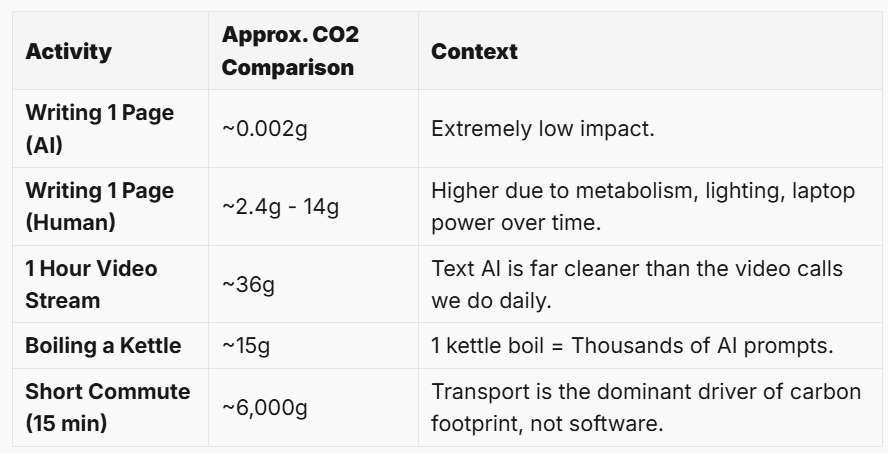
A 2024 study published in Nature (Scientific Reports) conducted a comparative life cycle assessment of AI systems versus human labor. The study found that AI systems emit between 130 and 1,500 times less CO2e (carbon dioxide equivalent) per page of text generated compared to human writers.
The Context:
Human Labor: Requires sustained energy consumption over hours (office lighting, HVAC, computing power, and the carbon footprint of the commute).
AI Labor: processing a text query takes seconds of server time.
The Takeaway: While AI data centers are energy-intensive, the efficiency of the tool means the carbon cost per specific output (like a newsletter draft) is often lower than the manual alternative.
Read the study here: The carbon emissions of writing and illustrating are lower for AI than for humans (Nature)
2. Distinguishing "Training" from "Inference"
It is important to understand where the energy consumption happens.
Training: This is the process of teaching the model. It requires massive computational power running for months. This is where the headline-grabbing energy statistics come from.
Inference: This is the act of using the model (e.g., asking WIZE to rewrite an email).
For the end-user, "Training" is a sunk carbon cost—similar to the energy used to manufacture a car. "Inference" is the energy used to drive it.
Recent benchmarking of "inference energy" shows that while image and video generation are heavy energy consumers, text-based inference is computationally efficient. A typical text query uses a tiny fraction of the energy required for video streaming.
Reference: One hour of HD video streaming emits approximately ~36g of CO2. To match that footprint, a user would need to run thousands of text-based AI prompts.
3. The Net Impact Calculation
For nonprofits, the decision often comes down to a "Cost vs. Benefit" analysis.
If an organization uses AI to generate content that serves no purpose, that is a net negative for the environment. However, if the efficiency gains from AI allow a development team to secure funding for climate protection, medical research, or community support, the "carbon investment" of the tool may be justified by the impact of the work funded.
Summary of CO2 Impact of Different Activities
Conclusion
There is no denying that the tech sector has work to do in decarbonizing data centers. As consumers, we should demand transparency and renewable energy sourcing from providers.
However, the data suggests that for the day-to-day work of fundraising—drafting, segmenting, and planning—text-based AI serves as a low-carbon alternative to traditional, time-intensive manual workflows.
Each organization must weigh these factors according to their own values, but the research indicates that efficiency and sustainability are not necessarily at odds.