From "Prompting" to "Plumbing": Why Context is the Real AI Power-Up
If you’ve spent any time with a generic AI tool, you know the routine. You write a prompt. You rewrite it. You add more detail, then a little more, trying to coax the AI into giving you something usable. This is prompt engineering: the art of crafting the perfect request to get a good result.
It’s a necessary skill, but it's also a time-consuming one. And for fundraisers who are already "wearing all the hats," it's another task on an endless to-do list.
But what if the secret to better AI wasn't just about what you ask, but what the AI already knows?
This is where the conversation is shifting from prompt engineering to a more powerful concept: context engineering.
Prompt Engineering: Giving an Intern a To-Do List
Prompt engineering is the manual craft of writing specific instructions for a single AI task. As one AI expert described it, it’s like “giving a brilliant but inexperienced intern a hyper-detailed to-do list for a single assignment.”
The success of the output depends entirely on the clarity and precision of your instructions in that single moment. You have to tell it everything it needs to know, every single time. This is why results can be fragile; a prompt that works today might not work tomorrow if the model updates or if you forget a key detail.
Context Engineering: Giving the Intern the Entire Project File
Context engineering is the automated science of building systems that consistently feed an AI all the information it needs to handle complex jobs. It’s not about the prompt alone; it's about architecting the entire information environment around the prompt.
Instead of a one-time to-do list, you’re giving the intern the full briefing: the complete project history, relevant data files, and a guide to the company’s voice and tone.
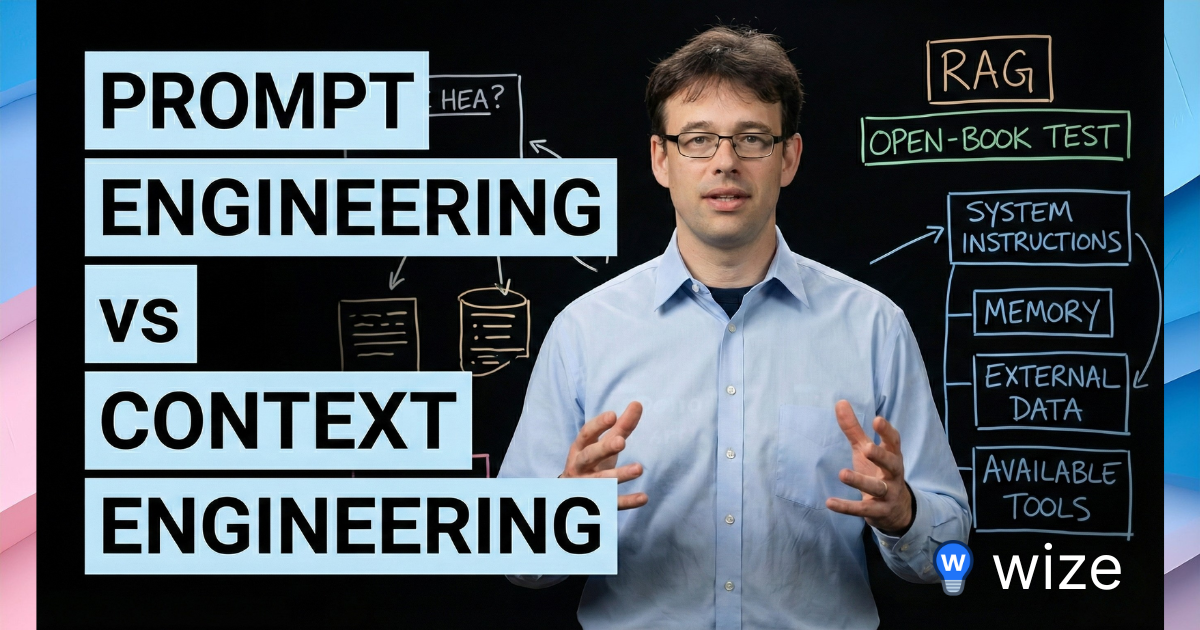
This is what’s happening in advanced AI systems. The "context" isn't just your prompt. It's a combination of things:
System Instructions: The base rules for the AI's behavior and personality.
Memory: The history of your conversation and past interactions.
External Data: Information pulled from documents, databases, or websites.
Available Tools: The skills the AI can use, like searching the web or your documents.
Some of us in the field have jokingly started calling this work "context plumbing"—all the foundational work that has to happen behind the scenes to make the magic happen.
How It Works: The "Open-Book Test" for AI
A key technique in context engineering is something called Retrieval-Augmented Generation (RAG).
Think of it as the difference between a closed-book and an open-book test.
A generic AI model is taking a closed-book test. It can only answer based on the vast, but general, knowledge it was trained on months or years ago.
An AI using RAG is taking an open-book test. When you ask it a question, it first retrieves relevant information from a specific set of documents (its "notes") and then uses that information to generate a better, more accurate answer.
This is how an AI assistant can know specifics about your nonprofit—your mission, your programs, your recent successes—without you having to type it all out in the prompt.
When you use a specialized tool like WIZE, you're seeing context engineering in action. The use of Assistants, the automated search of your documents… it's all part of a system designed to handle the "context plumbing" for you, so you can focus on the fundraising work that matters most.